The AI Assistant for Publishers That Actually Fits Into Your Workflow
How intelligent, context-aware assistance is quietly transforming the day-to-day of publishing operations — and why the biggest gains aren't where you'd expect.
Publishing has always been a process-heavy industry. Contracts, rights clearances, royalty calculations, metadata management, title setups — every step involves layers of decisions, institutional knowledge, and system navigation that can take years to master. And yet, most of the friction isn't in the complexity of the work itself. It's in all the small interruptions between the work: "Where do I find that report again?" "How do I set up an installment plan?" "What does this field actually mean?"
Multiply those micro-questions across a team of editors, rights managers, royalty specialists, and operations leads — and you start to see how much time quietly disappears each week. This is where the right AI assistant for publishers can make a measurable difference, not by replacing publishing expertise, but by putting answers exactly where people need them, right when they need them.
The Hidden Cost of Institutional Knowledge
In most publishing houses, knowledge lives in people's heads. A senior royalties specialist knows exactly where to find the contract amendment screen. A veteran rights manager can navigate the system blindfolded. But what happens when a new team member joins? When someone is covering a colleague's responsibilities? When staff turnover means that expertise walks out the door?
The traditional answer has been documentation — wikis, training manuals, internal how-to guides. They're valuable, but they're passive. Users have to remember they exist, know where to find them, and then parse through them to get to the specific answer they need. In practice, people just ask a colleague. And that colleague stops what they're doing to help.
An AI assistant for publishers changes this dynamic entirely. Instead of tribal knowledge locked in documentation or in-demand colleagues, it provides an always-available, context-aware layer of support that can answer questions in plain language, guide users through processes step by step, and even navigate the system on their behalf.
What "Harmonizing Workflows" Actually Looks Like
The phrase gets used a lot — but what does it mean in practice for a publishing operation?
Onboarding becomes self-service. A new editor learning a publishing management system doesn't need to shadow a senior colleague for weeks. They can ask the assistant how to set up a new title, what each field means, or how the approval process works — and get an accurate, documentation-backed answer immediately.
Cross-departmental handoffs get smoother. When a rights manager needs to understand how a royalty calculation was structured, or when an operations lead needs to know the status of a contract workflow, they can ask in plain language rather than building expertise in a system that isn't their primary domain.
Repetitive support requests drop significantly. The questions that get asked most often — how to run a specific report, how to find a particular record, what a specific system concept means — can be handled by the assistant rather than routed through IT support or team leads.
New processes are adopted faster. When system updates or new modules roll out, adoption usually lags because users don't know how to use the new features. An embedded assistant can explain changes, walk users through new workflows, and reduce the gap between release and confident use.
Beyond Q&A: The Emerging Role of AI in Publishing Operations
The immediate value of an AI assistant for publishers is reactive: answering questions, explaining concepts, guiding navigation. But the real long-term potential lies in a more proactive role.
As an analyst, a publishing AI assistant could allow teams to ask data questions in plain language — "Which titles from last year have unresolved rights queries?" or "What were total royalty payments across the backlist last quarter?" — and surface answers directly, without building custom reports or waiting for an IT request.
As an agent, it could handle multi-step workflows with user approval at key points: pre-filling new title records, drafting contracts from existing templates, creating internal tickets, or guiding contract compilation with intelligent suggestions based on established patterns.
As an orchestrator, it could connect publishing systems to the broader technology ecosystem — pushing metadata updates, creating leads in CRM systems, submitting titles to distributors, or sending status notifications to collaboration tools — reducing the manual coordination that currently sits between platforms.
These aren't distant possibilities. They represent a natural progression from where the technology is today, toward a future where the publishing management system becomes a genuine operational hub rather than a database that requires constant manual tending.
What to Look for in an AI Assistant for Publishers
Not every AI tool is built with publishing operations in mind. When evaluating options, a few criteria matter more than they might initially appear:
Domain specificity. A general-purpose AI can answer general-purpose questions. But publishing has its own terminology, workflows, and system logic. An assistant trained on publishing-specific documentation — contracts, royalties, rights, metadata standards — will give far more accurate and actionable guidance than a generic tool.
System integration. An assistant that sits outside your publishing management platform adds a context-switching step that undermines its value. The most effective implementations are embedded directly into the system, so users can ask questions and navigate without leaving their workflow.
Privacy and data governance. Publishing data — author contracts, royalty rates, rights agreements — is sensitive. Any AI assistant handling queries in that environment must meet strict data residency and privacy requirements. EU hosting, GDPR alignment, and clear commitments that your data is never used to train external models are baseline expectations, not nice-to-haves.
Honest scope. The best AI assistants for publishers are clear about what they know and what they don't. An assistant that confidently answers out of scope is more dangerous than one that says "I'm not sure — here's where to find out."
The Practical Starting Point
The most effective path to realizing these benefits isn't a sweeping transformation project. It's identifying the highest-friction points in your current workflows — the questions your team asks most often, the processes where new staff consistently get stuck, the handoffs that rely on one or two key people — and addressing those first.
An AI assistant that handles even a fraction of those interruptions frees up meaningful time. And because it's available to every user, at any skill level, the benefits compound across the entire team rather than concentrating in a single department.
See It in Action
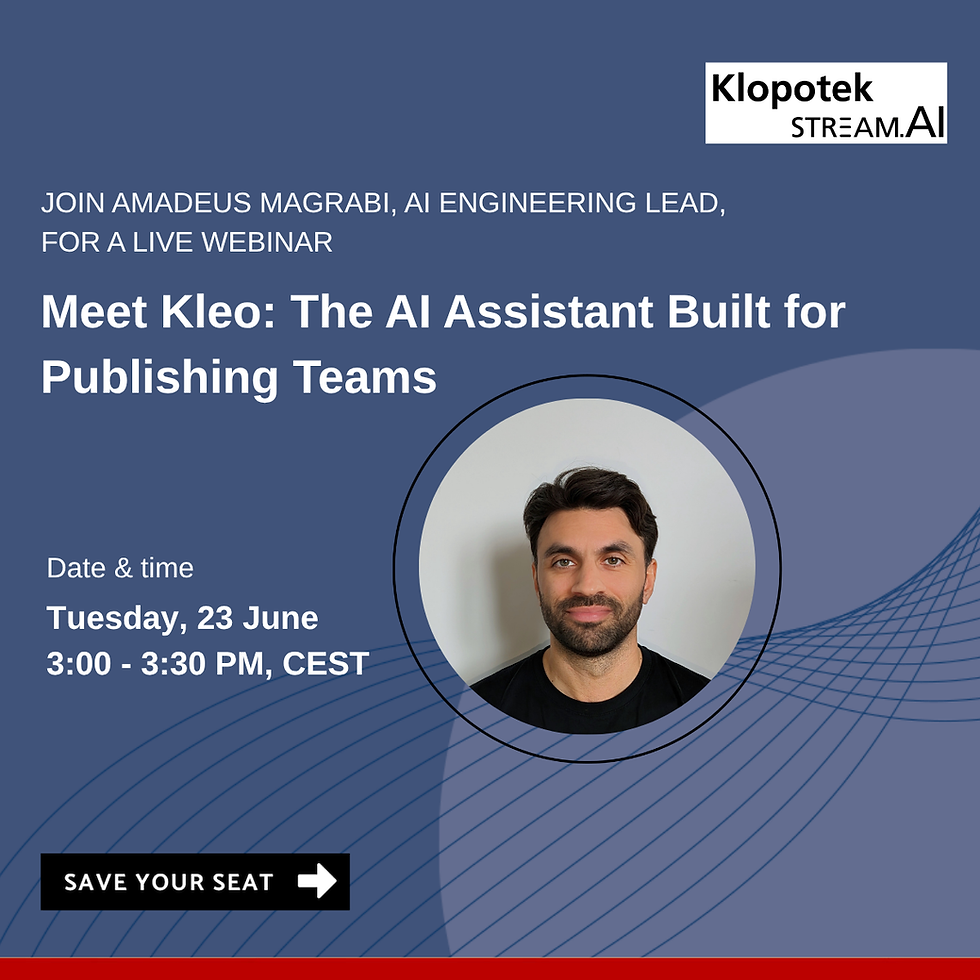
Klopotek's Kleo is an AI assistant built directly into the STREAM publishing management platform — designed specifically for the workflows, terminology, and operational questions that publishing teams face every day.
We're hosting a free live webinar to demo Kleo in action, walk through where the technology is headed, and answer your questions directly.
Free Live Webinar: "Kleo in Action" Tuesday, 23 June 2026 — 3:00 PM Berlin & Paris / 2:00 PM London / 9:00 AM New York Presenter: Amadeus Magrabi, AI Engineering Lead, Valsoft
Klopotek STREAM is a publishing management platform supporting operations, contracts, rights, royalties, and title management for publishers worldwide. Contact us to learn more!