AI Workflow in Publishing: Cutting Through the Hype to What Actually Works
The publishing industry is no stranger to buzzwords. But few have generated as much excitement — and confusion — as artificial intelligence. AI tools are everywhere. The promises are bold. And yet, for many publishers, the day-to-day reality still looks a lot like manual metadata cleanup, marketing copy written from scratch, and spreadsheets running the show.
So what does a real AI workflow look like in a publishing operation? And is AI actually saving your team time — or just adding more to think about?
Why Most AI Initiatives Stall Before They Start
Publishers aren't – of course – resistant to change. Most are genuinely curious about AI and actively looking for ways to reduce manual workload. The problem is the gap between what AI is marketed to do and what it demonstrably does today.
Too many AI tools for publishers arrive as vague productivity promises — "10x your output," "automate everything" — without showing the actual software doing actual work. The result is teams that are interested in principle but unsure where to start, and leadership that's skeptical of yet another tech investment without a clear ROI.
A sustainable AI workflow doesn't start with disruption. It starts with identifying the repetitive, high-volume tasks that drain team capacity — and applying focused automation precisely there.
Where AI Delivers Real Productivity Gains in Publishing Operations
There's a meaningful difference between AI that could theoretically help and AI that's ready to integrate into your existing publishing stack today. Here are the areas where the productivity case is already clear:
Metadata Generation and Cleanup
Metadata quality directly affects discoverability — and maintaining it is relentlessly time-consuming. AI-assisted metadata tools can generate, validate, and enrich metadata at scale, dramatically reducing the manual review burden on editorial and operations teams. A well-implemented AI workflow here doesn't replace human judgment; it handles the volume so your team can focus on the exceptions.
Marketing Copy and Blurb Creation
Writing jacket copy, catalogue descriptions, and promotional blurbs for hundreds or thousands of titles per season is a significant resource drain. AI tools trained on publishing conventions can generate high-quality first drafts that teams then refine — shifting the work from blank-page creation to editing and brand alignment. That's a meaningfully different (and faster) task.
Royalty and Contract Management
Royalty management is one of the most complex operational areas in publishing — prone to manual error, difficult to audit, and time-intensive to run. AI-assisted workflows can flag discrepancies, surface anomalies in royalty statements, and reduce the reconciliation burden on finance and rights teams. This is an area where automation pays for itself quickly.
Ticketing and Internal Request Handling
Operational teams field a constant stream of internal requests — corrections, clarifications, approvals. AI-powered ticketing systems can categorize, prioritize, and route these requests automatically, reducing response times and freeing staff from inbox management.
What to Look for in an AI Workflow Tool for Publishers
Not every AI tool is built for the specific requirements of book publishing. When evaluating options, these factors matter:
Integration with existing systems. An AI workflow that requires you to rebuild your stack from scratch will create more disruption than value. Look for tools that work alongside your current publishing platform and data infrastructure.
Transparency about what the AI is doing. Black-box automation creates new risks in a domain where accuracy matters — royalty calculations, contract terms, rights restrictions. The best tools make their logic legible.
A realistic scope. Beware vendors who claim AI can do everything. The most effective publishing AI tools are purpose-built for specific tasks — metadata, copy generation, royalty management — rather than generic productivity platforms bolted onto publishing workflows.
Genuine demos, not slide decks. If a vendor can't show you working software, the technology probably isn't ready.
See a Real AI Workflow in Action: Klopotek's STREAM.AI Tools

On Wednesday, 27 May, Klopotek is hosting a live 30-minute demo session designed specifically for publishers who want to see AI in action — not hear about it in theory.
The session will explore:
Where AI delivers real productivity gains in publishing operations
How to automate metadata, marketing copy, and reduce manual workload
What AI-assisted royalty management could look like in practice
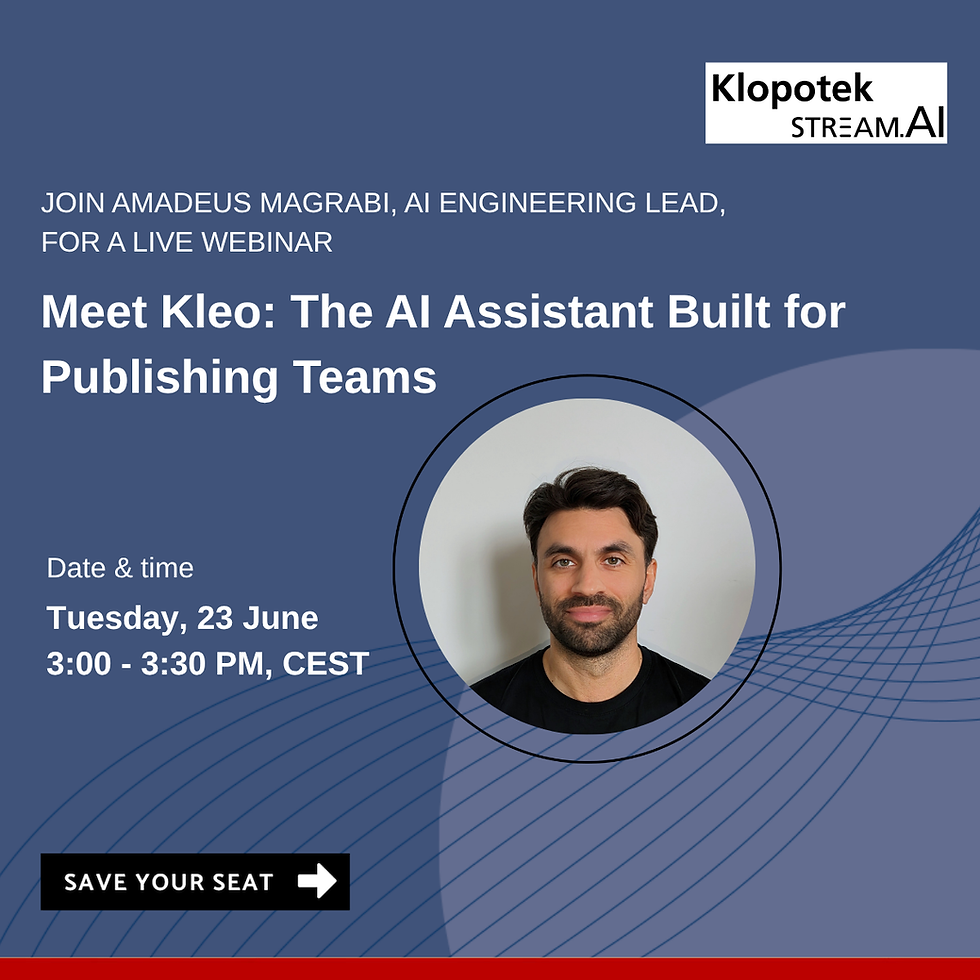
A live look at Klopotek's STREAM.AI tools — Blurb Manager, Kleo AI Assistant, and Ticketing — in action
Webinar details: 🗓 Wednesday, 27 May 🕒 3:00–3:30 PM Berlin/CEST · 2:00 PM London · 10:00 AM New York
No vague promises. Just working software and honest answers about what AI can realistically do for your workflows today.
The Bottom Line on AI Workflow for Publishers
AI is not going to replace editorial judgment, rights expertise, or the creative work that makes publishing valuable. What it can do — when implemented thoughtfully — is absorb the high-volume, repetitive operational work that slows teams down and introduces error.
The publishers who will benefit most from AI over the next few years won't be the ones who adopt every new tool. They'll be the ones who identify the right problems, choose focused solutions, and build AI into their workflows in a way that's sustainable and measurable.
That starts with seeing real tools, doing real work. Join us on 27 May.
Klopotek provides enterprise software for the publishing industry, including the STREAM.AI product suite and CRR (Contracts, Rights & Royalties) platform. Contact us!